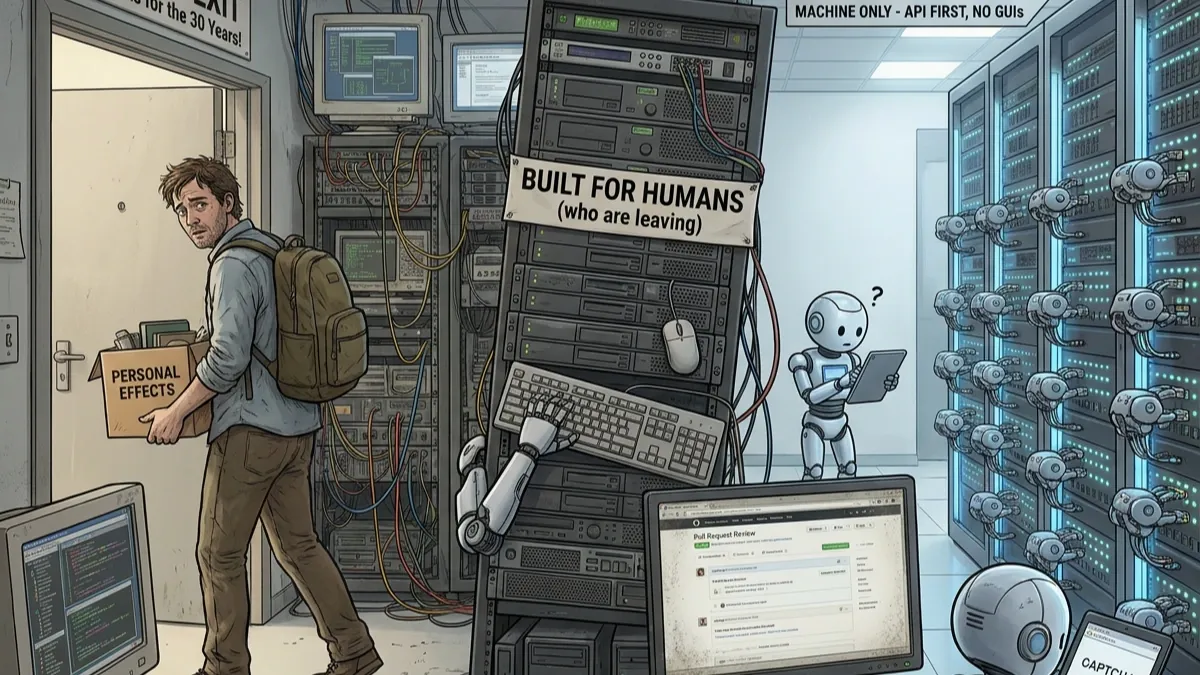
The whole stack was built for a human. The human is leaving.
Why the next cloud and the next GitHub have not been built yet, and who gets to build them.
Forget who owns the data centre for a minute. That is the wrong argument anyway. The question worth asking is simpler and a lot more uncomfortable. Who is the software actually for?
For the last thirty years the answer never changed. A person. Everything we built assumes a human sat at the other end of it. The web app is a human reading a screen. The desktop app is a human clicking a button. GitHub is a human reviewing a diff and deciding whether to hit merge. The cloud console is a human navigating menus to stand up a server. Every layer of the stack, from the IDE down to the IAM policy, was shaped around human eyes, human hands and human patience.
And here is the bet. That person is starting to leave the room.
I am not claiming the desktop dies next Tuesday. This will take years and plenty of it will be messier than the demos suggest. But the direction is not subtle. More and more of the work is being done by agents. They write the code, they run the tests, they open the change, they read the logs, they call the API. The human is moving from the one doing the work to the one supervising it, and eventually to the one who just reads the summary. When that happens, the customer of your software is no longer a person. It is a process. And nothing we built was made for that customer.
Think about what a machine actually wants from a platform, because it wants almost the opposite of what a human wants. A human wants a tidy console, sensible defaults, a gentle onboarding and a dashboard that tells a story. A machine wants none of that. It wants an API that is the product itself and not an afterthought bolted onto the side of a website. It wants to provision in milliseconds, not minutes, because it has no patience to spend and no coffee to fetch while it waits. It wants to spin up a thousand of something, do the work, and throw it all away a second later. It wants credentials scoped to exactly one job that expire the moment that job is done, not a human-shaped login with a human-shaped set of permissions. It does not want to look at anything. It wants to read everything.
That is why I think the real opening is not a cheaper hyperscaler. It is a cloud built machine-first. You can already see the shape of it forming. A whole crop of platforms has appeared in the last year whose entire pitch is giving an agent somewhere to run. Sub hundred millisecond provisioning. Ephemeral by default. Hardware isolation because the thing executing is untrusted code an agent has only just written. Billed by the second because nothing lives longer than the task. These are not nicer virtual machines. They are a different primitive, built for a workload that arrives in bursts of thousands and then vanishes. Daytona pivoted its whole business to this and now sells start times under a hundred milliseconds. E2B runs the agent’s freshly written code inside hardware-isolated microVMs and will hand you a thousand of them at once. Modal and Vercel are circling the same ground from their own angles. None of them are AWS, and that is the point. The general purpose cloud can offer this, and it will, but it is retrofitting a model designed for the old customer. The interesting players are building for the new one from the first line of code.
Now run the same exercise on GitHub, because this is the example that makes it click for me. GitHub today is racing to become the place agents do their work. It hosts hundreds of millions of repositories and it is bolting agent features onto every step of the loop. But it is still, at heart, a website built around a human ritual. The pull request exists so a person can look at a change and approve it. The whole product has its gravity centred on that one moment of human review. That ritual does not survive contact with an agent making hundreds of micro-commits a minute. You cannot review that. You do not even want to.
An agent-native code host inverts the whole thing. The API comes first and the website becomes a viewing gallery you wander into when something actually needs your attention. Creating a repository is a function call. Permissions are scoped to a single ephemeral agent doing a single task, not a human seat with a role. Branch comparison, file inspection and history are primitives an agent reads, not pages a human scrolls. A push fans out through webhooks to tests, evaluations, previews and deployments on its own, and the human review queue becomes just one more consumer of those events rather than the centre of the universe. Early versions of exactly this are already shipping. Freestyle sells Git as infrastructure for agents, API first, with repositories created by function call and permissions scoped per agent, rather than a developer website with an API stapled on the back. Cloudflare has a beta that brings Git-style versioning to whatever an agent produces. Neither is a household name yet, and that is rather the point.
The clever part is that the format probably survives even as the platform gets torn down and rebuilt. Agents speak Git fluently because they were trained on a world that is soaked in it. So this is not a new file format or a new protocol. It is a new shape. The same Git underneath, a completely different platform around it, built on the assumption that the primary user has no eyes.
This is also why I am more optimistic about a real leapfrog here than I ever was about the infrastructure layer. The incumbents’ great moat has always been the network of humans already on the platform and the comfort of the familiar interface. The moment the customer is a machine, both of those turn from assets into dead weight. A process does not care about your collaboration features or your lovely UI. It will route around anything slow or human-shaped without a second thought, because it has no loyalty and no habits and nothing to relearn. That is a far weaker position to defend than a data centre full of power and chips.
I will be honest about the other side of it, because the temptation with a post like this is to get carried away. The incumbents are not going to stand there and watch. GitHub is sprinting to become the agent runtime and it has every repository in the world to defend. The hyperscalers will ship their own agent primitives and may simply swallow this whole layer the way they have swallowed every layer before it. There is a genuine chance the new cloud and the new GitHub turn out to be new products inside the old companies rather than new companies at all. And the margins on the early agent runtimes are already thinning, which usually means the value drifts up into orchestration and the runtime underneath becomes a commodity nobody makes money on.
But the assumption underneath the entire stack is changing, and that is the thing to watch. For thirty years the question every platform answered was how do I make this pleasant for a person. For the next thirty it is how do I make this fast and legible for a machine, with the person watching from a window. Whoever builds for that customer first, and refuses to compromise it to keep the old one comfortable, has a real shot at being the thing everything else runs on.
That is the leapfrog. Not a cheaper place to park a server. A platform built, finally, for a user who is not us.
Originally published on linkedin.com.