The Generation That Was Accidentally Built for AI
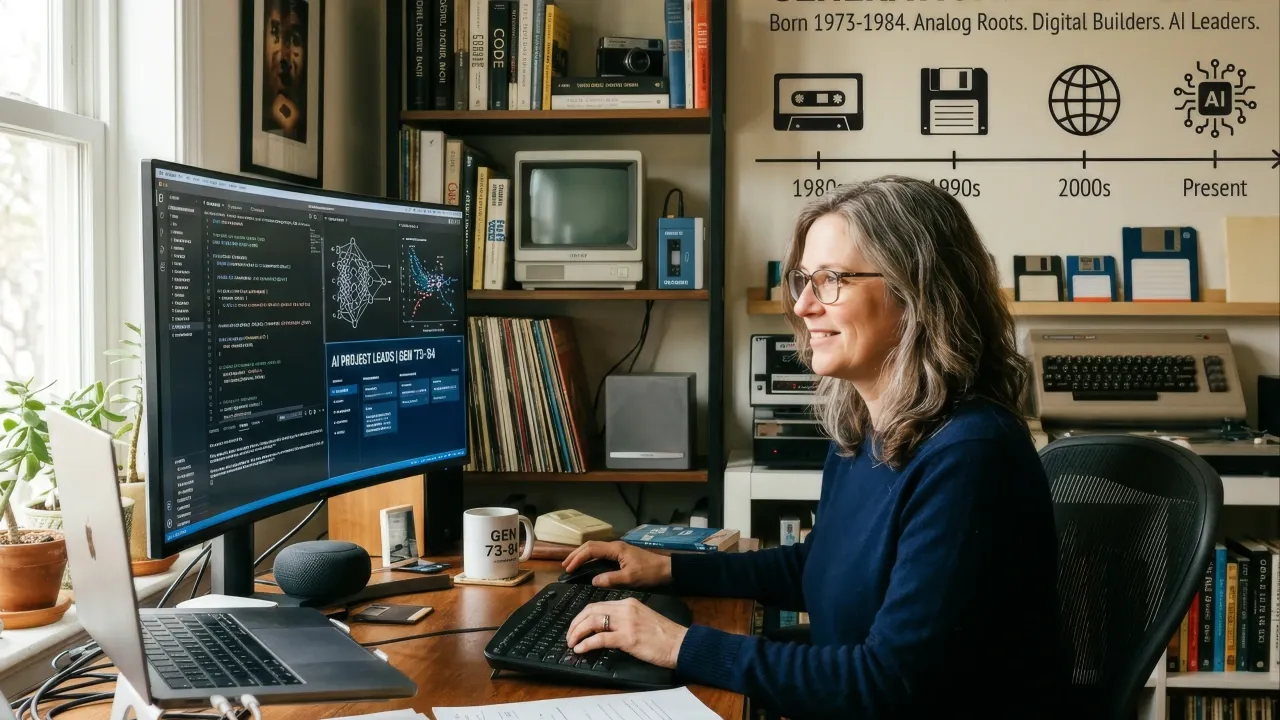
Born between 1973 and 1984, this cohort lived through the analog era, built the digital era, and is now in a strange position to lead the AI era.
I’ve been thinking about why some people take to AI tooling like it’s obvious while others, often very talented engineers, freeze up or quietly ignore it and hope it goes away.
I don’t think it’s about technical skill. I think it’s about when you were born and what you lived through getting here.
There’s a generation of people, roughly born between 1973 and 1984, who have lived through three completely different technological eras. Not read about them. Not studying them. Lived them, hands on, at the right age for each transition to leave a mark.
The analog era. The digital era. And now, the AI era.
Some people call this cohort Xennials. Others call them the Oregon Trail Generation, after the old computer game we all played in school while pretending it was educational. The Oxford English Dictionary added “Xennial” in 2021, which feels about right for a generation that’s always been slightly too late for one label and slightly too early for the next.
The labels don’t matter though. The lived experience does. And I think that experience, the specific sequence of it, accidentally produced a type of thinker that the AI era happens to reward.
The analog foundation
I grew up in a world where information was physical. If you wanted to know something, you went to the library. You pulled an encyclopaedia off the shelf. You asked someone who might know, and if they didn’t, you were stuck until you found someone who did.
There was no Google. There was no Stack Overflow. There was no “just ask the AI.”
This matters more than it sounds. When you can’t instantly look up the answer, you learn to reason from what you already know. You learn to break problems down, work from incomplete information, and build mental models before you have any external confirmation that you’re on the right track. You get comfortable being wrong for a while, because being wrong was normal. It was just how you figured things out.
Those of us who got into computers early, the Sinclair ZX81 kids, the Commodore 64 kids, the ones who begged their parents for a Spectrum or saved up pocket money for a second hand Amiga, learned something else. We learned to work within brutal constraints. Limited memory. Limited storage. No internet to download a library that does the hard bit for you. If you wanted the computer to do something, you had to understand how it worked at a low level. You configured IRQ settings. You edited autoexec.bat and config.sys. You understood file systems and memory allocation not because you were clever, but because the machine refused to cooperate unless you did.
Nothing was abstracted away. Nothing was magic. Everything was visible, everything was manual, and if it broke, you were the one figuring out why.
I didn’t realise it at the time, but this was training. Patience. First principles thinking. Comfort with constraints. An instinct to understand the “why” behind systems rather than just the “how.” All of it was being quietly installed. And it turns out that’s what you need when you’re sitting across from an AI model, trying to decide whether its output is right, and you can’t just take its word for it.
We didn’t just watch the digital transformation, we built it
The second era hit this generation at the right time.
We entered the workforce in the late 1990s and early 2000s, right as the internet was going from curiosity to infrastructure. We didn’t inherit the digital world. We helped build it. The first web applications, the first e-commerce platforms, the first internal tools that replaced paper processes. We were there, often writing the code ourselves, often making it up as we went because there was no playbook yet.
And then the stack changed. And we adapted. And then it changed again. And we adapted again.
Java gave way to .NET gave way to Ruby gave way to Python. Waterfall became Agile, DevOps became Platform Engineering. Monoliths became microservices became serverless and containers became… Well, it’s still coming. Every few years, the tools we’d spent the previous few years mastering were suddenly obsolete, and we had to start learning again. Not from a textbook, but on the job, under pressure, with production systems depending on us getting it right.
That cycle, learn, apply, master, discard, repeat, is something this generation has practiced more than any other cohort in tech. It’s not just a technical skill either. It’s a psychological one. The ability to sit with the discomfort of being a beginner again, to resist clinging to what you already know, and to trust that you’ll figure it out because you’ve figured it out before. That doesn’t come from a course. It comes from doing it five or six times and surviving.
Meanwhile, we watched entire industries get disrupted around us. Music went from CDs to Napster to iTunes to Spotify in the time it took us to go from university to mid career. Media went from newspapers to blogs to social platforms. Retail went from catalogues to e-commerce to marketplace platforms that made the e-commerce look quaint. We didn’t read about disruption. We had front row seats, and often a hand on the controls.
That gives you something hard to quantify but impossible to fake: pattern recognition. You’ve seen what a paradigm shift looks like from the inside. You know the early signals. You know the difference between real transformation and hype. That kind of judgement matters right now, because the AI conversation is drowning in both.
Why this cohort fits the AI era
In my previous blog post, I argued that the future of software engineering is less about writing lines of code and more about architecture, security, systems thinking, and being the human in the loop who ensures the AI agents don’t break what they’re building. That the engineer of tomorrow needs a broad foundation, not just fluency in a programming language.
What I didn’t say, but have been thinking about since, is that the generation born between 1973 and 1984 already has most of those skills. Not because they’re smarter. Because they spent twenty-plus years acquiring them the hard way, before any of it could be automated.
You can’t evaluate AI generated code if you’ve never written code yourself. And you definitely can’t catch an architectural flaw in an AI proposed design if you’ve never designed a system from scratch and watched it fall over at 2am. The same goes for security. I’ve seen AI agents produce configurations that look perfectly reasonable on the surface. You’d only know they were wrong if you’d configured it by hand before and lived with the consequences of getting it wrong.
This generation has done all of that. Over and over, for decades. They know what good looks like because they’ve built good, and plenty of bad, with their own hands.
McKinsey’s research on the future of work points to something they call the “AI translator,” the person who can sit between what AI can do and what the business actually needs. Someone who can take a messy, ambiguous business problem and turn it into something an AI system can act on, then look at the output and judge whether it actually solves the original problem.
That’s what this generation has been doing for their entire career. They explained the internet to the boomers. They explained legacy systems to the millennials. Twenty years of being the bridge between the people who understand the technology and the people who understand the business. Now AI needs exactly that bridge, and they’re already standing on it.
There’s one more thing worth saying here. This generation doesn’t blindly trust tools.
We grew up in an era where the computer was frequently wrong. Software crashed. Data got corrupted. The answer the system gave you was only as good as the assumptions baked into it. We learned to verify. To test. To challenge. To never assume that because the machine said it, it must be right.
That scepticism turns out to be pretty useful right now. The people who get into trouble with AI are the ones who treat it like an oracle, who take the output at face value and ship it without looking. The people who get the most out of AI treat it more like a colleague who’s very capable but occasionally makes things up. You check their work before it goes out the door.
The pushback
I can hear the counterarguments already.
“Younger generations are digital natives. They’ll adapt faster.” Maybe. But being a digital native means you’ve never not had the tools. You’ve never had to reason without them. When the tools change, and they are changing constantly right now, the people who learned to think without the tools tend to handle it better than those who never had to.
Think of it like cooking. A chef who learned over a fire and then moved to induction has a deeper set of instincts than a chef who’s only ever used induction. When a completely new cooking technology arrives, the first chef has more to draw on. Not because fire is better than induction, but because they’ve already been through the “everything I know just changed” experience and come out the other side.
“This is just generational ego.” Fair. I want to be clear though: this is not a “we’re better than you” argument. Every generation brings different strengths. Gen Z has an intuitive comfort with AI interfaces that most people in my cohort are still developing. Millennials built the social and mobile platforms that defined the last decade. The argument isn’t about superiority. It’s that this particular moment in technology happens to reward the specific experiences of this particular cohort, and the industry would be silly to ignore that.
“AI will make domain expertise irrelevant anyway.” This is the one I disagree with most. As AI gets better at execution, and it is getting better fast, the value doesn’t disappear. It shifts. It shifts to the person who can specify what to execute and evaluate whether the execution is correct. That takes domain knowledge. The kind you build over years of doing the work yourself. AI doesn’t make expertise irrelevant. If anything, it makes expertise the only thing that matters.
What this actually means
If you’re a hiring manager, stop filtering out candidates over 40. I get it, younger candidates are cheaper. But the calculus has changed. In the AI era, the person who costs you more on paper is often the one who stops an AI agent from shipping a security hole into production, or catches the architectural flaw that would have taken six months to untangle. That experience premium is real, and the cost of not having it in the room is harder to see on a spreadsheet but much more expensive when it goes wrong. Pair someone from this cohort with a younger engineer who brings fresh AI native instincts. That combination is more productive than either person alone.
If you’re part of this generation yourself, don’t sit on your experience and assume it’s enough. The analog to digital journey gives you a head start, not a free pass. If you’re not actively engaging with AI tools, building agentic workflows, experimenting with multiple models, and keeping up with the pace of releases, your advantage erodes every day you sit still. Pattern recognition only works if you’re paying attention to the current pattern.
And if you’re an educator, the skills gap I wrote about in my last post, junior engineers arriving with programming language fluency but no foundation in architecture, security, or systems thinking, maps directly to what this generation learned through experience. The challenge is compressing twenty years of experiential learning into a curriculum . Apprenticeships. Constraint based projects. Simulated production environments. Stop teaching people how to code. Start teaching them how to think about systems.
The accidental training ground
Nobody planned this. Nobody sat down in 1978 and said “let’s raise a generation of kids who’ll be ready for the AI era forty five years from now.” It was just timing.
But the accident produced something useful. Analog taught us to think from scratch. Digital taught us to keep learning when everything changed. And now AI is here, and it happens to reward both of those things more than anything we’ve seen before.
The world has changed. Again. But some of us have been training for this our whole lives, even if we didn’t know it at the time.
Originally published on linkedin.com.